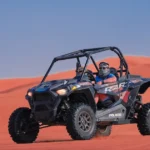
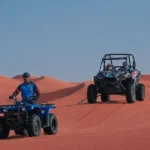
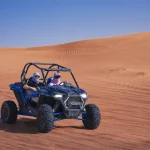
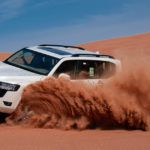
Desert driving is harder than it looks because the terrain is constantly changing. Unlike paved roads or race tracks, the desert has no fixed route, no consistent grip, and no predictable surface.
Every dune is different, and drivers must continuously adjust their speed, steering, and vehicle control based on the changing sand conditions.
Many people watch videos of dune bashing or dune buggy rides and think driving across the desert looks easy. In reality, it requires specialized training, practical experience, and a good understanding of how both the vehicle and the desert behave. This is why professional safari guides in Dubai undergo off-road driving training before taking guests into the dunes.
In this article, we’ll explain how desert driving is different from circuit driving, why traction and speed feel different on sand, how professional drivers read the dunes, why tyre pressure matters, and why guided desert driving is always the safest option for first-time visitors.
Circuit Driving Happens on Predictable Surfaces
Circuit driving takes place on a fixed and predictable surface, making it very different from driving in the desert.
Race tracks are built with asphalt or other hard surfaces that provide consistent grip for the tyres. Every corner, braking zone, straight section, and racing line remains the same every time a driver completes a lap.
Because the track never changes, drivers can memorise the layout and improve their performance with every lap. They know exactly where to brake, when to accelerate, and how each corner behaves.
Even though circuit driving requires excellent driving skills, the environment itself is controlled. The surface, corners, and conditions are designed to remain as consistent as possible.
Desert driving is completely different because the terrain is never the same twice.
Sand Driving Is Constantly Changing
Sand driving is constantly changing because the desert itself is always changing.
Unlike a race track, the desert has no fixed roads or permanent routes. Strong winds regularly reshape the dunes, changing their height, angle, and surface throughout the day. A route that was safe in the morning may feel completely different by the evening.
Drivers must also understand the difference between soft sand and compact sand. Softer sand provides less support for the vehicle, while firmer areas offer better grip and control. These conditions change depending on the weather, wind direction, and how many vehicles have already driven through the area.
Another challenge is the shape of the dunes. Slopes, ridges, blind crests, and hidden drop-offs can change over time, making every drive slightly different from the previous one.
This is why desert safari guides receive specialized off-road training and licensing before driving guests into the dunes. Unlike circuit driving, they cannot rely on memory alone. Every drive requires them to read the terrain and make decisions based on the conditions in front of them.
Traction Works Completely Differently on Sand
One of the biggest differences between desert driving and circuit driving is how the tires interact with the surface.
On paved roads and race tracks, tires grip the hard surface, allowing drivers to brake, accelerate, and turn with confidence. The amount of grip remains fairly consistent throughout the drive.
In the desert, the tires behave very differently. Instead of gripping a hard surface, they sink slightly into the soft sand. This reduces traction and makes the vehicle feel as though it is floating or gliding across the dunes rather than firmly holding the ground.
To keep moving smoothly, drivers rely on maintaining the right amount of momentum. If the vehicle slows down too much while climbing a dune, the tires can dig deeper into the sand and become stuck. If the driver accelerates or steers too aggressively, the vehicle may lose stability on the loose surface.
Professional desert drivers learn how to balance speed, steering, and momentum so the vehicle moves smoothly across the dunes while remaining under control.
This unique driving style is one of the main reasons why desert driving feels completely different from driving on a road or a race circuit.
Speed Feels Different in the Desert
Driving fast is not what makes desert driving challenging. Even at lower speeds, driving across the dunes can feel much more intense than driving on a road or a race track.
The height and steepness of the dunes create a different driving experience. As the vehicle climbs a dune, you may only see the sky before reaching the top. When descending, the slope can feel much steeper than it actually is.
Unlike circuit driving, where speed is often the focus, desert driving is about maintaining control. Drivers constantly adjust the vehicle’s speed depending on the shape of the dunes, the condition of the sand, and the route ahead.
Professional safari guides focus on smooth acceleration, controlled steering, and maintaining the right momentum instead of simply driving as fast as possible. This allows the vehicle to move safely across the soft sand while still giving passengers an exciting experience.
Braking and Turning Require Different Techniques
Although both circuit driving and desert driving require skill, the way drivers control the vehicle is completely different.
| Circuit Driving | Desert Driving |
| Heavy braking before corners is common | Sudden braking is avoided because the tyres can dig into the sand. |
| Drivers rely on high grip from the road surface. | Drivers work with limited grip on loose sand. |
| Sharp and precise steering is possible. | Smooth and gradual steering gives better control. |
| Sharp and precise steering is possible. | Smooth and gradual steering gives better control. |
| Racing lines remain the same every lap. | Every route changes depending on the dunes and weather. |
| The focus is speed and lap consistency | The focus is momentum, balance, and vehicle control. |
In desert driving, smooth inputs are much more important than sudden movements. Abrupt braking, sharp steering, or rapid acceleration can reduce stability and make the vehicle harder to control.
This is why experienced desert drivers appear calm behind the wheel even while driving across steep dunes.
Reading the Terrain Is One of the Most Important Skills
Professional safari guides constantly observe the dunes and adjust their driving based on what they see ahead.
Some of the things they look for include:
- Wind-shaped dune ridges.
- The height and angle of the slope.
- Changes in the color and texture of the sand that indicate softer areas.
- Hidden drop-offs behind dune crests.
- The safest angle to climb or descend each dune.
These observations help guides decide where to drive, how fast to approach a dune, and which route will provide the safest and smoothest experience.
Unlike a race track, the desert does not have marked routes. Every decision is based on the driver’s ability to read the terrain correctly.
Why Tire Pressure Matters So Much on Sand
Before entering the dunes, safari guides reduce the tire pressure of their vehicles. This is one of the standard safety procedures followed before dune bashing begins.
Lower tire pressure increases the tire’s footprint, which means a larger part of the tyre touches the sand. This spreads the vehicle’s weight over a wider area.
As a result, the tires stay closer to the surface instead of digging deep into the soft sand. Many people describe this as the vehicle “floating” over the dunes.
Reducing tire pressure also improves traction, makes the vehicle easier to control, and lowers the chances of getting stuck during the drive.
If the tires remain fully inflated, they create a smaller contact area with the sand. This causes the tires to sink more easily, reduces grip, and makes the vehicle more difficult to drive on loose dunes.
Once the dune bashing experience is over, the tires are inflated back to their normal pressure before returning to public roads. This ensures the vehicle is safe and performs properly on paved surfaces.
Which Requires More Skill – Sand Driving or Circuit Driving?
Both sand driving and circuit driving require a high level of skill, but the skills are very different.
Circuit driving focuses on precision, braking points, racing lines, and maintaining consistent lap times. Since the track remains the same, drivers improve by repeating the same course and refining their technique.
Desert driving is much less predictable. Drivers must constantly read the terrain, adjust to changing sand conditions, manage vehicle momentum, and choose the safest route across the dunes.
The table below highlights the main differences.
| Circuit Driving | Desert Driving |
| Fixed racing circuit. | Constantly changing terrain |
| Predictable grip throughout the track | Grip changes with every dune |
| Precision and consistency are the priority | Adaptability and terrain reading are the priority |
| Drivers memorise the racing line | Drivers read the landscape in real time. |
| Heavy braking is part of racing. | Smooth braking helps maintain momentum |
| Track conditions change very little | Wind and weather continuously reshape the dunes |
Neither type of driving is easier or better than the other. They simply require different skills.
Desert driving should never be underestimated. It requires specialized off-road training, practical experience, and, for professional safari guides, the appropriate license and certification before carrying passengers into the desert.
What First-Time Desert Drivers Usually Get Wrong
Many first-time drivers assume that driving on sand is similar to driving on a road. In reality, the techniques are completely different.
Some of the most common mistakes include:
- Turning the steering wheel too sharply.
- Braking too hard on soft sand.
- Accelerating too aggressively while climbing a dune.
- Underestimating how deep and soft the sand can be.
- Looking only a few meters ahead instead of reading the terrain further in front.
These mistakes can reduce the vehicle’s control and increase the chances of getting stuck.
This is why desert driving should not be treated like normal road driving. Professional safari guides spend years developing the skills needed to safely drive across changing desert terrain.
Why Guided Desert Driving Matters
Guided desert driving is the safest way to experience the dunes, especially for first-time visitors.
Professional guides understand how the desert changes throughout the day. They know how to read the terrain, choose safe routes, and adjust their driving according to the weather and sand conditions.
Guides also communicate with other safari vehicles throughout the journey. This helps them manage convoy movements, share updates about changing conditions, and respond quickly if assistance is needed.
If a vehicle becomes stuck, trained guides know how to recover it safely using the correct recovery techniques and equipment.
For activities such as dune bashing, guided dune buggy tours, and quad biking, experienced supervision gives visitors the confidence to enjoy the adventure while reducing unnecessary risks.
Rather than driving alone in an unfamiliar environment, following a professional guide allows you to experience the desert safely while learning from people who understand the terrain.
Desert driving is much more challenging than it appears. Unlike roads and race tracks, the desert is constantly changing, requiring drivers to adapt to new terrain, changing sand conditions, and unpredictable weather throughout the journey.
While circuit driving focuses on precision and consistency, desert driving depends on reading the landscape, maintaining vehicle momentum, and making the right decisions at the right time. This is why professional desert drivers undergo specialized training before guiding visitors across the dunes.
At Trawey, we believe that a great desert driving experience is built on skill, safety, and experience. Our professional safari guides are trained to handle changing desert conditions while ensuring every guest enjoys an exciting, well-controlled, and comfortable adventure.
Ready to Experience Desert Driving?
Explore Trawey’s guided dune buggy, quad biking, and Dubai desert safari experiences and discover the thrill of off-road driving with experienced professional guides.
Frequently Asked Questions
Yes, in many ways. Sand driving requires drivers to constantly adapt to changing terrain, while circuit driving takes place on a fixed track.
Because sand provides less grip. The tires move over loose sand instead of gripping a hard surface like asphalt.
To improve traction. Lower tire pressure helps the tires float over the sand and reduces the chances of getting stuck.
Not when it is professionally guided. Experienced guides follow safety procedures and choose suitable routes for visitors.
Drivers need to understand terrain, maintain momentum, control the vehicle smoothly, and adapt to changing sand conditions.
Yes. Many guided dune buggy experiences allow tourists to drive after receiving safety instructions and following the guide.
Because of the changing terrain. Even at moderate speeds, steep dunes, loose sand, and constant elevation changes make the experience feel much more exciting than driving on a normal road.