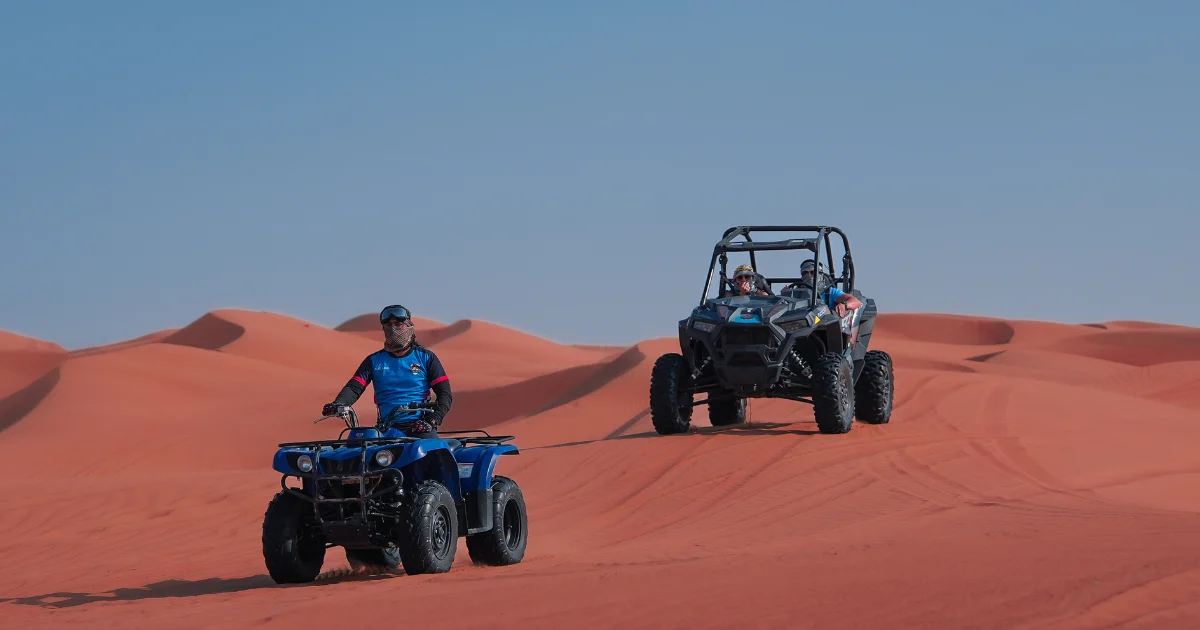
Driving a dune buggy is one of the most exciting activities in a Dubai desert safari. Unlike dune bashing, where a professional driver controls the vehicle, a dune buggy lets you drive through the desert at your own pace while following a guided route.
Many first-time visitors assume that off-road driving is difficult. In reality, most dune buggy tours are designed for beginners. If you have basic car driving experience, learning to drive a dune buggy is usually straightforward. The vehicles are easy to operate, and every tour starts with a safety briefing before entering the desert.
Most operators also give you two options. You can drive the buggy yourself or ride as a passenger while an experienced guide takes the wheel. Riding with a guide is a good option for visitors who are not yet confident about driving on sand.
This guide focuses on first-time riders. It explains how beginner-friendly dune buggy tours work, what happens before the ride starts, how to control the vehicle, common mistakes to avoid, and simple techniques that make driving on sand much easier.
Can a Complete Beginner Drive a Dune Buggy in Dubai?
Yes. Most dune buggy tours in Dubai are designed for people with little or no off-road driving experience.
Unlike experienced off-road riders who may drive in the open desert, beginners usually start in controlled riding areas with more stable terrain. The guide leads the convoy from the front, and every rider follows the same route. This means you don’t need to worry about planning the route or getting lost in the desert.
The vehicles are also built to make off-road driving easier. Most beginner buggies include:
- Automatic transmission
- Wide tyres for better grip on sand
- Low centre of gravity for improved stability
- Strong suspension for uneven terrain
- Simple controls similar to a regular car
Although you control the steering and throttle, the ride is still guided. The guide sets the pace, gives instructions along the way, and adjusts the route based on the group’s experience and the desert conditions.
Before entering the desert, every rider attends a safety briefing. This covers vehicle controls, convoy rules, communication signals, speed limits, and emergency procedures. Taking a few minutes to understand these instructions makes the ride much more comfortable, especially for first-time riders.
What Happens Before the Ride Starts?
Every dune buggy tour follows a few important steps before entering the desert. These steps help riders become familiar with the vehicle, understand the safety rules, and make sure everyone is ready before the convoy starts moving.
Although the process may vary slightly between operators, most guided tours include a safety briefing, safety gear distribution, and a short vehicle familiarization session.
Safety Briefing (15–20 Minutes)
The safety briefing is the first part of every dune buggy tour. It usually lasts 15 to 20 minutes and is mandatory for all riders, regardless of their driving experience.
During the briefing, the guide explains:
- Vehicle controls
- The route you will follow
- Convoy rules
- Speed limits
- Communication signals
- Emergency procedures
- What to do if the buggy gets stuck or develops a problem
The guide also explains how the buggy behaves on sand and the basic riding techniques needed for the tour. Pay close attention during this session. A clear understanding of the rules makes the ride much more comfortable and helps avoid common beginner mistakes.
Safety Gear Distribution and Fitting
Before the ride begins, every rider receives the necessary safety equipment. Wearing the gear correctly is just as important as knowing how to drive the buggy.
Most operators provide:
1. Helmet
- A properly fitted helmet protects your head during the ride.
- It should fit securely without being too tight or too loose. A loose helmet can move while driving, while a tight helmet may become uncomfortable during longer rides.
2. Goggles
- Goggles protect your eyes from sand, dust, and strong winds.
- Even on calm days, the buggy in front can throw small amounts of sand into the air, making eye protection essential.
3. Gloves (Optional)
- Some operators provide gloves, while others allow riders to bring their own.
- Gloves improve grip on the steering wheel and help reduce hand fatigue caused by vibration on rough terrain.
4. Neck Scarf or Balaclava
- A neck scarf or balaclava helps cover your mouth and nose during dusty conditions. It also prevents sand from blowing directly onto your face while riding.
Vehicle Familiarisation Before Departure
Before the convoy leaves, most operators give riders a few minutes to become familiar with the buggy. This is the best time to understand where everything is and how the controls feel before driving on sand.
Check the following:
- Locate the throttle and brake pedals.
- Press each pedal gently to understand how they respond.
- Turn the steering wheel from side to side to feel its movement.
- Adjust the driver’s seat so you can comfortably reach both pedals.
- Fasten your seatbelt or safety harness correctly.
Ask the guide if anything is unclear before the ride begins.
Understanding the Controls Before You Drive
A dune buggy has the same basic controls as a regular car. The main difference is how the vehicle responds on soft sand. Small steering movements, smooth throttle control, and gentle braking keep the buggy stable throughout the ride.
Before entering the desert, take a moment to understand the three controls you’ll use most—the steering wheel, throttle, and brake pedal.
1. Steering Wheel
The steering wheel feels familiar if you’ve driven a car before. However, a dune buggy responds more quickly because it is built for off-road driving. Large steering movements are rarely needed. Small adjustments are usually enough to keep the buggy on the guide’s track.
One of the most common beginner mistakes is oversteering. Turning the wheel too sharply can make the buggy unstable or take it away from the convoy. A simple rule is to let the buggy respond before turning the wheel further. If you feel the need to steer more, pause for a moment. The vehicle may already be changing direction.
Tips
- Keep both hands on the steering wheel.
- Make smooth steering corrections.
- Avoid sudden left or right turns.
- Follow the guide’s track instead of creating a new path.
2.Throttle (Accelerator Pedal)
The throttle controls how much power reaches the wheels. On sand, smooth throttle control is more important than speed.
Most dune buggies used for guided tours have an automatic transmission, so there is no need to change gears. The right foot controls both the throttle and the brake. Press the throttle gently until the buggy reaches a comfortable pace. Once you’re moving, try to keep the pressure steady instead of repeatedly pressing and releasing the pedal.
A steady throttle gives the tyres better traction and helps the buggy stay balanced on loose sand.
Tips
- Apply pressure gradually.
- Keep a steady pace on flat sand.
- Avoid sudden acceleration.
- Follow the guide’s speed instead of trying to drive faster.
3. Brake Pedal
The brake pedal is mainly used when the guide asks the convoy to slow down or stop. Unlike normal road driving, frequent braking is not necessary on sand.
Pressing the brake too hard can reduce the buggy’s stability, especially on uneven terrain. During dune descents, the guide may ask you to apply light braking or allow the buggy to slow down naturally. Always follow these instructions instead of reacting suddenly.
Tips
- Brake smoothly and progressively.
- Avoid sudden braking on soft sand.
- Leave enough distance from the buggy in front.
- Follow the guide’s signals before stopping.
Automatic vs. Manual Dune Buggies
Most dune buggy tours in Dubai use automatic vehicles because they are easier to drive and suitable for beginners.
With an automatic buggy, your main focus is controlling the steering, throttle, and brake. There are no gear changes, allowing you to concentrate on the terrain instead of the transmission.
Manual buggies require much more experience. Driving on sand involves constant changes in terrain, making gear selection and clutch control more challenging. Even experienced road drivers may find manual dune driving difficult without previous off-road experience.
For this reason, automatic buggies are the preferred choice for almost all guided desert tours.
Before booking, ask the tour operator which type of buggy is included. Most beginner packages use automatic vehicles, but confirming this in advance helps avoid surprises on the day of your ride.
Correct Driving Position and Why It Matters
A correct driving position improves control and reduces fatigue during the ride. Many beginners focus on the steering and throttle but overlook their seating position. Poor posture often leads to oversteering, tired shoulders, and slower reactions on uneven terrain.
A few simple adjustments before the ride can make the buggy easier to control.
Seat Position
The seat should allow you to reach both pedals comfortably without stretching your legs.
When pressing the throttle fully, your knees should remain slightly bent. Sitting too far back makes it harder to control the pedals, while sitting too close can make your legs feel cramped during the ride.
Your back should stay fully supported by the seat throughout the journey.
Tips
- Keep a slight bend in your knees.
- Sit upright with your back against the seat.
- Adjust the seat before leaving the base camp.
- Make sure you can comfortably reach both pedals.
Hand Position on the Steering Wheel
Both hands should stay on the steering wheel throughout the ride.
The recommended position is similar to the 9 o’clock and 3 o’clock positions on a clock face. This provides better control when driving over uneven sand.
Avoid steering with one hand or placing your hands at the top of the wheel. Desert terrain can cause the steering wheel to move suddenly, making it harder to stay in control.
Tips
- Hold the wheel at the 9 and 3 o’clock positions.
- Keep both hands on the wheel.
- Avoid crossing your hands while turning.
Elbow Position
Your elbows should remain slightly bent rather than fully straight.
Bent elbows absorb some of the bumps from the terrain, making steering more comfortable over long distances. Straight arms transfer every vibration directly to your shoulders, causing fatigue much sooner.
A relaxed grip also helps you make smoother steering corrections.
Foot Position
Your right foot controls both the throttle and the brake.
Keep your heel resting on the floor whenever possible. This gives you better control over the throttle and makes it easier to apply smooth pressure.
Your left foot should rest comfortably on the footrest or floor. Since most beginner buggies are automatic, it is not used for driving.
Mastering Throttle Control
Throttle control is the most important skill when driving a dune buggy. It affects traction, stability, and how the buggy responds on different parts of the desert.
Smooth and steady throttle control is usually more effective than frequent acceleration or braking.
Driving on Flat Sand
Once the buggy reaches a comfortable speed, keep the throttle steady.
Constantly pressing and releasing the accelerator can reduce traction and make the ride less smooth.
If you’re riding in a convoy, match the guide’s pace instead of trying to speed up or slow down unnecessarily.
Tips
- Apply steady throttle pressure.
- Avoid sudden acceleration.
- Maintain a safe distance from the buggy ahead.
Climbing a Dune
Approach the dune with steady momentum.
The buggy already has enough speed before reaching the base of the dune, so there is usually no need to accelerate sharply at the last moment.
Maintain gentle, consistent throttle pressure throughout the climb. Sudden changes in speed can reduce traction and make the ascent less stable.
Always follow your guide’s instructions, as every dune is different.
Crossing the Crest
The crest is the highest point of the dune where the climb changes into the descent.
This is a transition point, not a place to accelerate.
Keep the steering wheel straight, hold a steady throttle, and wait for the buggy to settle before beginning the descent.
Avoid sudden steering movements or hard braking at the top of the dune.
Descending a Dune
Let the buggy roll down naturally under its own weight.
Keep both hands firmly on the steering wheel and look towards the bottom of the dune instead of directly in front of the vehicle.
Avoid pressing the throttle while descending unless instructed by the guide. If braking is needed, apply light and gradual pressure instead of sudden braking.
What to Do If You Feel Nervous During the Ride
Feeling nervous during your first dune buggy ride is completely normal. The desert looks different from regular roads, and it takes a few minutes to get used to driving on sand. The best approach is to stay calm and let the buggy do the work.
Slow Down: Ease off the throttle and reduce your speed gradually. Avoid pressing the brake suddenly, especially when driving on a dune. A slower, steady pace gives you more time to react and regain confidence.
Relax and Breathe: Many beginners grip the steering wheel too tightly when they feel anxious. This often leads to oversteering and quicker arm fatigue.
Take a slow breath, loosen your grip slightly, and keep your shoulders relaxed.
Look Ahead: Looking directly in front of the buggy makes every bump feel bigger than it is.
Keep your eyes on the guide or the path ahead. Looking further ahead helps you steer more smoothly and anticipate the terrain.
Stay on the Guide’s Track: The guide chooses the safest route through the desert. Following the same track makes the ride easier and reduces unnecessary steering corrections.
Avoid creating your own path unless instructed to do so.
Let the Guide Know: If you need a short break or feel uncomfortable, use the communication signal explained during the safety briefing. The guide can stop the convoy when it is safe to do so and help you before continuing the ride.
Trust the vehicle: dune buggies are built for soft sand and uneven terrain. Wide tyres, a low center of gravity, and off-road suspension help keep the vehicle stable even when the surface feels unfamiliar. Stay relaxed, keep your steering smooth, and avoid sudden movements. For more peace of mind, you can also read our essential health and safety tips for desert safaris.
Stay relaxed, keep your steering smooth, and avoid sudden movements.
Frequently Asked Questions
No. Most dune buggies are automatic and designed for beginners.
No. Guided tours are suitable for first-time riders.
Usually no, but requirements vary between operators and tour types. Always confirm before booking.
Most operators provide a 15–20 minute safety briefing before the ride.
Yes. Inform your guide using the agreed communication signal if you need a break.
Automatic buggies. They are easier to control and are used on most beginner tours.
Slow down, stay on the guide’s track, and follow their instructions. There’s no need to rush.
Driving a dune buggy for the first time is much easier than many people expect. Guided tours are designed for beginners, and every ride starts with a safety briefing, proper equipment, and time to become familiar with the vehicle before entering the desert.
Understanding the controls, maintaining a good driving position, and using smooth throttle inputs are the three skills that make the biggest difference. Once you’re comfortable with these basics, driving across the dunes becomes much more enjoyable.
At Trawey Tours, beginner riders are guided through every step before entering the desert. From the safety briefing to the final ride, our experienced guides ensure you feel comfortable, confident, and safe throughout the experience.
Book your Dubai Dune Buggy Tour with Trawey Tours and experience the desert with expert guidance, beginner-friendly vehicles, and unforgettable views.