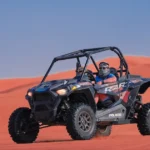
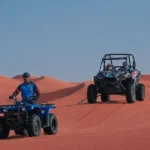
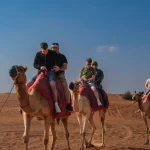
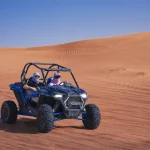
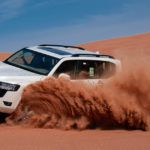
The vast spread of golden dunes is the perfect picture backdrop any photographer dreamed of – where every trail on the sand tells a story. But to truly capture the essence of the desert, more than just having a camera and knowing the techniques is not enough. You have to be prepared well, understanding the environments and how to navigate creatively and responsibly.
In this guide, we will walk you through all the information you need to know about desert safari photography. If you want to leave the capturing to the experts, you can book professional photography & videography to ensure every memory is perfectly recorded.
Recommended Camera Equipment for Desert Photography
Capturing the essence of desert is about having the right equipment. Here is what you should pack for the perfect photography experience.
1. Best Cameras for Desert Safari
When it comes to desert safari photography, having the right camera is essential. DSLRs, mirrorless cameras, and action cameras work exceptionally well in desert photography. They offer high image quality, stability, and the ability to change the lenses for different occasions.
DSLR: It is the best option as it has the following features, like
- Long Battery Life: Battery drainage is fast in the desert due to the climate; DSLRs last longer as compared to other cameras.
- High Image Quality: DSLRs having large sensors produce more detailed and sharp images with high quality.
- High Dynamic Range: Deserts often have contrasting shades and shadows, so in order to capture them at their best, DSLRs are the best option.
- Wide Range of Lenses: DSLRs offer a wide range of lenses, including wide-angle to capture landscapes and telephoto for focusing on finer details.
- Video Shooting Option: DSLRs offer the option for video shooting as well.
Mirrorless Camera: It has features like
- Lightweight and Compact: Mirrorless cameras are easy to handle, having a very compact size and less weight compared to others.
- Electronic View Finder (EVF): Mirrorless cameras offer EVF, which helps you to get a clear image even in bright light.
- High Stability: Image stabilization in mirrorless cameras offers less blurry images on unstable, sandy ground even when shooting handheld.
- High ISO Performance: Desert shooting is known for its golden hour magic, which involves low lighting. This morning desert safari perfect for photography offers the best natural light for capturing high-quality images .
- Wide Range of Lenses: A wide range of lenses, from wide-angle to capture the vast landscape to telephoto to capture the finest details, can be used.
- Advanced Autofocus System: A mirrorless camera is an ideal option if you want to capture a moving object like a desert animal or ride a camel. The autofocus system can quickly and accurately capture the moving object.
Action Cameras: It excels in desert photography due to features like
- Ruggedness and Durability: Desert photography includes harsh weather conditions and dust particles. Action cameras are designed in such a way that they have the ability to withstand harsh climates.
- RAW Shooting: Action cameras allow photographers to shoot RAW footage and are flexible enough to get an amazing click post-processing.
- Wide Range of Lenses: Action cameras offer a wide range of lenses, allowing you to capture vast landscapes to the finest details with various lenses from wide-angle to telephoto.
- High-Resolution Images: It offers high image quality with the finest details for capturing the unique texture of the desert.
- Shockproof and Waterproof: Action cameras have features like waterproof and shockproof, allowing you to capture near water bodies or in challenging terrain.
- Small and lightweight: It is very small and easy to carry and the best option if you are a full-time explorer.
2. Essential Lenses for Desert Photography
The desert offers you versatile options to capture its beauty. You will need the right lens according to your purpose.
Wide-Angle Lenses: This is the best option for capturing the vast desert landscapes, including horizon lines and foreground details. Some of the advantages of wide-angle lenses are
- Capturing wide landscapes: Deserts are limitless, and you will get some good clicks just by clicking the beautiful desert landscapes in a single frame.
- Focus on texture and details: It is the best option for capturing the smallest and finest trails in deserts, like footprints, vehicle traces, etc.
- Highlight both background and foreground: They excel in capturing the depth by highlighting the elements in the foreground and background.
- Versatility of shots: They can capture the long-distance objects to the close-up shots perfectly.
Telephoto lenses: They compress the vastness of the desert pretty easily. Some of the advantages of telephoto lenses include
- Compression: Telephoto compresses the vast landscapes by making the distant subjects appear nearby.
- Detail and focus: The finest details, like patterns on sand or the focused click of a desert plant – with these lenses, it is easy to capture the details.
- Highlight light and shadow: It highlights the light and shadow contrast of the desert and the sky or any other subjects, especially during the golden hour when the light is low.
- Capturing rich colors: Telephoto lenses can capture richer colors during sunrise and sunset. To get the most vibrant sky gradients, aim to capture the desert at sunrise when the shadows are deepest and the light is softest.
- Image stabilization: Image stabilization is offered especially to capture moving subjects or those in unstable terrain.
3. Tripods and Stabilizers for Better Shots
Desert photography is a dream for every photographer, but using a tripod provides the stability needed for sharp shots in the wind. For the best results without crowds in your frame, book a private safari for exclusive photo access to the most scenic dunes.
A tripod: A tripod provides better stability for your camera even in windy conditions and is ideal for your long exposure clicks. Some of the benefits of using a tripod include
- Stability: It will give you and your camera a more stable position and posture for the perfect click.
- Long Exposure Shots: It will allow you to capture the long exposure shot in a sharp frame and help you to focus more on the capturing than on the stability and positioning.
- Timelapse: Ideal for the time lapses of the desert, especially the sunrise and sunset or the starry sky.
- Flexibility: It gives you the creative flexibility to try out different shots and frames.
- Portability: Easy to carry and wander around the desert to get that perfect frame.
4. Filters for Enhancing Desert Safari Photography
Desert photography is challenging for many reasons, and one of them is the harsh sunlight. Using the right filter will help you to get the perfect click.
Polarizing Filters: They help to reduce the glare from reflective lights and enhance the depth of the blue color of the sky. Some of the benefits of choosing the polarizing filter include
- Give more intensity to the blue sky.
- Reduce Sand Glare
- Helps to improve the contrast
- Helps to enhance the color saturation
Neutral Density Filters: They will help you to manage the heavy brightness and harsh sunlight, which is common in desert regions. The benefits of using ND filters are
- Helps to manage the brightness
- Creating motion blurriness in photos for that flow and creativity.
- Helps you to focus on the subject by blurring the background.
- It helps to click the photos of the sky without overexposing.
5. Drones for Aerial Photography in Dubai
- Unrestricted Perspective: Irrespective of the ground restrictions, drones can capture far from the limited territory.
- Accessibility: It can access what people can’t, like any remote region or any other restricted area for wildlife habitats.
- Dynamic Shot: It will capture stunning shots such as vehicles navigating through the desert or a falcon flying.
- Versatility: It can be paired with any kind of camera, including different lenses or sensors.
Aerial views of deserts are breathtaking, and drones will help you to capture them beautifully. Some of the benefits of using drones for aerial views are that
Safety Precautions for Camera Equipment
The climate of the desert can be very challenging, with winds, dust, and extreme heat, which will be a barrier for you to protect your equipment. Here’s how you can keep your equipment safe and functional.
1. Protecting Camera Equipment from Sand
The finest sand particles can enter the small gaps in the camera, which will harm the function of the camera and other equipment.
In order to protect yourself from fine dust particles, you need to have the following safety precautions included:
- Lens hood to shield from direct sunlight and act as a barrier against dust and sand particles.
- UV filters will protect your lenses from getting scratched by sand particles.
- Weather seals for your camera lenses to prevent sand particles from entering.
- Rainsleeves or ziplocks are used to cover the camera and lenses during strong wind.
- Cling wrapping to protect from the sticking of sand particles in small gaps of the camera and lenses.
2. Battery Management and Power Backup in the Desert
Having extra batteries and battery management is crucial in desert photography due to extreme weather conditions and longer duration. Some of the following challenges will be faced in the desert, including
- High temperatures cause quick battery drainage.
- You will be out in the middle of nowhere, and finding a place to recharge is impossible.
- Longer duration, from about 5 hrs to 12 hrs, or an overnight stay included.
3. Cleaning Your Camera After Desert Safari Photography
Cleaning your camera and lenses in between or after the shoot is compulsory due to the presence of dust and sand particles. You can use the following things for cleaning, including:
- Blower or soft brushes for removing loose dust
- Microfiber cloth for wiping the extra fine dust particles, but make sure you don’t make any scratches.
- Lens pen for cleaning the stubborn particles or stain
- Lens cleaning solution for gentle wiping off
Using Drones for Desert Safari Photography in Dubai
Taking photographs of the desert by using drones can capture the aerial views, but it is also important to know the restrictions of using drones in Dubai. Keep in mind the following things:
1. Understanding Drones for Desert Safari Photography in Dubai
Dubai is a place with strict laws about using drones, especially for videography and photography. Operating drones without proper registration may cause legal consequences. There are several steps you need to follow, including
- Register your drone with DCAA (Dubai Civil Aviation Authority) and GCAA (General Civil Aviation Authority) of UAE.
- Obtain an NOC (No Objection Certificate), especially if you are shooting any commercials.
- Stay out of the prohibited areas.
2 Safe Drone Operation in the Desert
Due to the weather conditions, like strong wind, dust, and rapid changing of daylight, drone usage can be a bit challenging. For a safe operation, you need to follow
- Operate during the calm climate, like during golden hour, to avoid high turbulence and wind.
- Keeps drone within your eyesight
- Avoid flying near any wild animals or moving cars and people.
Charging Camera Batteries During a Desert Safari
Stunning shots in the desert don’t just depend upon your skills but also on potential battery backup. With limited access to electricity and charging stations, it is important to carry extra batteries for your camera for a smooth operation.
1. Power Sources of Camera Equipment:
Here’s how to stay charged during the long journey:
- Portable power banks for your camera and phones
- Always carry extra fully charged battery packs.
3. Restrictions on Camera Equipment
While most travelers are allowed to use cameras during their trips, there are certain limits for photography, which include:
- Taking photographs of people without their consent
- Need special permission for commercial shoots
- No flash photos are allowed in Dubai Safari Park.
- Taking photographs of locals and their daily life routine could be seen as disrespectful.
At Trawey Tours, we understand the importance of capturing moments and memories. The right choice of cameras, lenses, and other equipment for protecting your belongings is the key to having a good photography experience.
Whether you are an amateur photographer or a professional, Trawey’s guided experiences make sure that you are at the right place at the right time.
Plan your trip with Trawey for the best photoshoot experience. If you are a content creator looking for the ultimate shots, you should book a professional photography desert tour today .