Before modern city culture, shopping malls, and digital entertainment, life in the UAE was simple and deeply connected to nature and community.
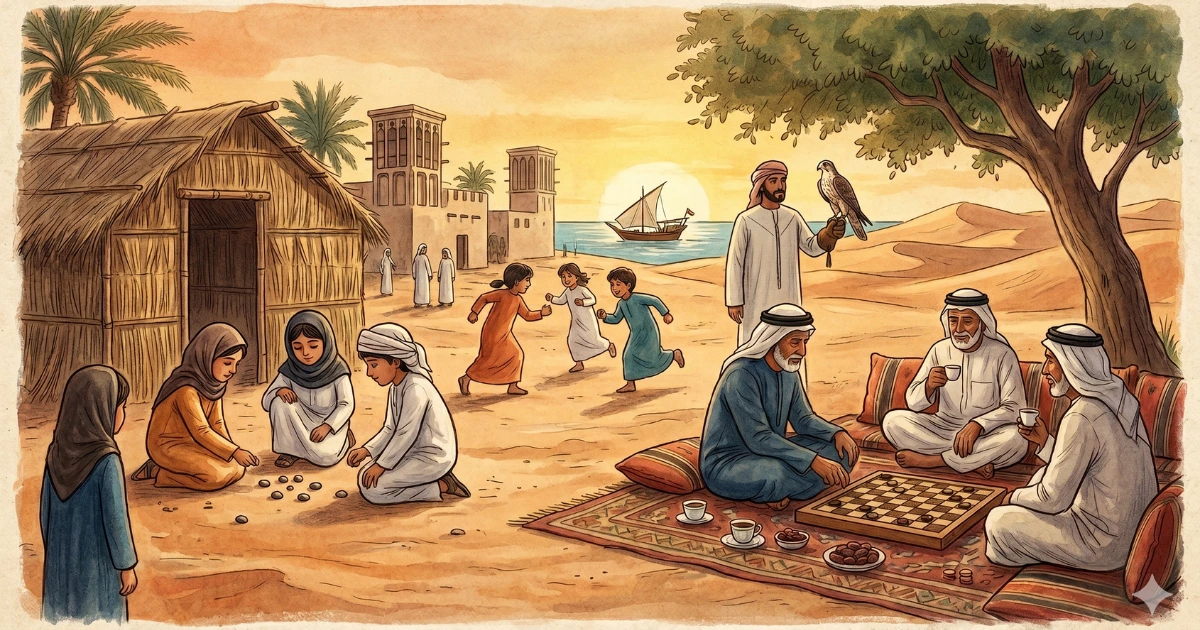
Younger children played in sandy streets and open courtyards, while adults gathered in the evenings to talk, play, share stories, or find solutions to community problems. These activities were not just for fun — they helped people develop important life skills and stay connected with each other.
Traditional Emirati games and pastimes reflect a way of life shaped by desert conditions, strong family values, and shared experiences. They taught patience, teamwork, creativity, and respect — all while using simple tools and natural surroundings. That same spirit of connection and tradition is still alive today in authentic Emirati desert camp experiences and cultural tours across the UAE.
In this article, we discuss what life was like before modern entertainment, traditional games played by children and adults, cultural values behind these traditions, and where visitors can experience them today.
Life Before Modern Entertainment in the UAE
Before the discovery of oil, daily life was slow and deeply connected to nature. People lived in desert and coastal communities where all activities were linked to the land, the sea, and daily responsibilities.
There were no televisions, internet, mobile phones, or digital devices of any kind. Free time was spent outdoors or in shared spaces where neighbors and families gathered to interact and support one another.
How free time was spent:
- Children played in open spaces and courtyards near their homes
- Families and neighbors gathered after the day’s work was done
- Storytelling, music, traditional games, and poetry were common evening activities
This communal way of life shaped a culture built on hospitality and togetherness — the same values visitors still encounter when they receive Arabic coffee and dates as a welcome gesture at a desert camp.
Traditional Emirati Children’s Games
Most children’s games in the UAE were simple but meaningful. They required very few materials, were played in groups, and helped children develop physical strength, coordination, and social skills.
1. Al Tabi
Al Tabi is a traditional chasing game played in groups, often in open sandy areas. One player takes the lead while others try to avoid being caught.
What it develops:
- Speed and agility
- Awareness and quick thinking
- Group interaction and cooperation
2. Al Karabi
Al Karabi is a team-based game that focuses on balance and coordination. Players work together while maintaining rhythm and movement — more like an art form than a competitive sport.
What it develops:
- Teamwork and group participation
- Physical balance and coordination
- An energetic, celebratory atmosphere
3. Al Hailah / Al Sagala
These are pebble-based games where players pick and move small stones in specific patterns. They require focus and careful hand movements and were typically played in courtyards or shaded indoor areas.
What they develop:
- Hand-eye coordination
- Concentration and patience
- Fine motor skills
4. Al Qirqee’an
Al Qirqee’an is a seasonal children’s tradition celebrated during mid-Sha’ban. Children go door to door singing traditional songs and collecting sweets from neighbors.
Key features:
- Group singing and community celebration
- Sharing and generosity as central values
- A tradition still practiced in some communities today
Traditional Games for Adults
Adults also had their own forms of entertainment, particularly during evenings and the cooler winter months. These activities were deeply social and often took place in the majlis — the traditional communal gathering space.
1. Al Dama
Al Dama is a strategy board game similar to checkers, played using simple pieces like stones or shells on a marked board. Sailors and pearl divers used to play this game during their downtime between voyages.
Key aspects:
- Focus on planning and strategy
- Played in a relaxed, social setting
- Encourages patience and careful thinking
2. Al Siga
Al Siga is a traditional board game played on lines drawn directly in the sand, using pebbles as pieces. Its simplicity made it accessible to everyone, anywhere.
Why it stands out:
- Can be played in any outdoor location
- Only two players needed with no special equipment
- Focuses on strategy and decision-making under simple rules
3. Al Barjees
Al Barjees is a dice-based board game popular across the Gulf region, combining luck and strategy in a highly social format. It was often played during gatherings alongside tea, coffee, and storytelling.
Game features:
- Combination of luck and strategic planning
- Played during group gatherings and celebrations
- Encourages conversation and social interaction
Popular Traditional Emirati Pastimes
Beyond games, several meaningful pastimes shaped daily and seasonal life in the UAE.
1. Falconry
Falconry is one of the most important traditional activities in the UAE — a survival skill that Bedouin people used for hunting in the desert, now recognized as a living cultural heritage tradition.
Why it matters:
- Represents deep heritage, patience, and skill
- Reflects the close connection between desert people and wildlife
- Still practiced and demonstrated at desert safari camps for visitors today
2. Pearl Diving Stories and Memories
Before oil discovery, pearl diving was a cornerstone of the UAE economy. Even after the industry faded, the stories, sea songs, and chants of the diving season remained a cherished part of cultural memory — representing bravery, hardship, and community solidarity.
3. Majlis Conversations
The majlis is the traditional gathering space where community members met to talk, share ideas, host guests, and resolve matters together. It was the social and cultural center of every neighborhood — the equivalent of a community living room. The spirit of the majlis lives on in every desert camp seating arrangement where guests sit together, share food, and exchange stories under open skies.
Cultural Values Inside Emirati Games
Traditional games were never just about entertainment. They reflected the core values that shaped Emirati society and continue to define it today.
Important values embedded in traditional play:
- Cooperation — many games required teamwork rather than individual competition
- Respect for elders — elders guided, taught, and observed games across generations
- Creativity — games used simple, natural materials like stones, ropes, and sand
- Teamwork — group play helped younger generations develop collaborative instincts
- Community bonding — shared activities strengthened relationships between families and neighbors
These values are still central to Emirati culture — and still visible in traditions like the henna rituals and communal storytelling sessions at desert camps.
Where Visitors Can Experience Emirati Traditions Today
Visitors can still encounter these traditions through cultural sites, festivals, and guided experiences across the UAE.
Al Fahidi Historical Neighbourhood
This area in Dubai offers a glimpse into old Emirati life with traditional wind-tower architecture, narrow lanes, and cultural programs — a window into how the Emirates looked in the 19th century.
Sheikh Mohammed Centre for Cultural Understanding
Located in Dubai, this center provides cultural meals, guided discussions, and immersive programs that explain Emirati traditions, daily life, and historic pastimes in an accessible and welcoming format.
Desert Camps and Cultural Tours
Desert safari camps are directly inspired by the Bedouin community and the way they lived while traveling the desert. These camps provide a real experience with traditional interiors, warm hospitality, and activities including:
- Falconry demonstrations
- Storytelling sessions
- Cultural activities inspired by traditional Bedouin life
Read our full guide on the cultural side of a desert safari experience to understand how much heritage is woven into a single evening on the dunes. For visitors exploring Abu Dhabi, the full-day Abu Dhabi city tour also covers heritage villages and sites that bring pre-oil Emirati life to life.
Why These Traditions Still Matter
Traditional games and pastimes help preserve cultural identity in a fast-changing world. They connect younger generations to their roots and offer a deeper understanding of how people lived, cooperated, and found joy before modernization arrived.
Why they matter today:
- They preserve cultural heritage for future generations
- They teach life values like patience, creativity, and teamwork
- They offer meaningful experiences for visitors beyond modern attractions
For travelers, these traditions provide a more complete picture of the UAE — one that goes far beyond its famous skyline.
Traditional Emirati games and pastimes show how people in the UAE lived, learned, and connected before modern development. Today, even with rapid modernization, the UAE continues to preserve these traditions and share them with the world. They are not just part of history — they are still alive in festivals, cultural centers, and community events.
Exploring these traditions adds real depth to any UAE visit. It allows travelers to experience the culture beyond modern attractions and understand the country’s true heritage.
Want to experience authentic Emirati culture?
With Trawey Tours, you get to discover traditions, stories, and pastimes that bring the UAE’s heritage to life — from falconry and storytelling at desert camps to heritage walks and cultural tours across Dubai and Abu Dhabi.