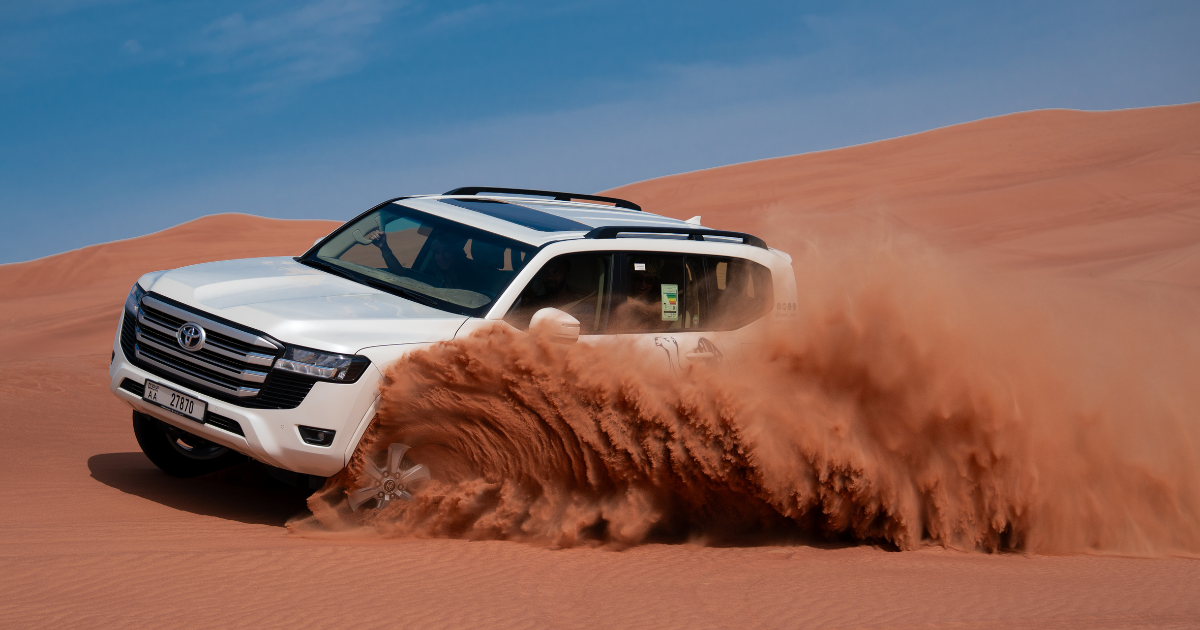
Encouraging your safari driver to go faster during dune bashing in Dubai’s desert can make the experience more dangerous than you realize.
In desert safaris around Dubai, dune bashing is already a controlled high-speed activity where trained drivers carefully balance speed, angles, and terrain. Asking them to “go faster” can disrupt that balance and increase the risk of sudden drops, sharp turns, or loss of control on soft sand.
Many travelers make this request out of pure excitement, not knowing that even small changes in speed can significantly affect how the vehicle handles dunes. This article explains what actually happens when speed increases in the desert, why drivers should not be rushed, and how you can enjoy a safer and more comfortable safari experience.
In this article, we discuss what actually happens when speed increases, how passengers influence drivers, the real risks of encouraging speed, and the legal and practical reality of regulated desert safari driving in the UAE.
Understanding the Real Impact of Speed
Speed in dune bashing directly affects how much control the driver has over the vehicle on sand. In the desert, the ground is soft, slopes are steep, and visibility can change instantly. Even a small increase in speed can reduce the driver’s ability to react and manage the vehicle safely.
Why Speed Matters More in the Desert
Driving on sand is fundamentally different from driving on roads. The surface is constantly shifting and unpredictable.
In dune bashing specifically:
- The vehicle moves on loose sand, not a solid or predictable surface
- Dunes have sharp drops and hidden slopes that cannot always be seen in advance
- The driver must continuously adjust speed while ascending and descending
This means speed must be carefully balanced — not too slow to lose momentum on climbs, and not too fast to maintain control on drops.
What Happens When Speed Increases
When the vehicle goes faster, three critical things change simultaneously:
1. Less Time to React
At higher speeds, the driver has significantly less time to respond to sudden changes such as:
- A steep blind drop immediately after a dune peak
- Another vehicle positioned ahead on the dune face
- A patch of soft sand that slows or pulls the vehicle unexpectedly
Even a difference of one or two seconds in reaction time can be the difference between a controlled descent and a dangerous one.
2. Longer Stopping Distance
The faster the vehicle moves, the longer it takes to slow down or stop:
- At lower speed — easier to reduce pace or stop before a hazard
- At higher speed — takes considerably longer to stop, and in the desert there are no guardrails or physical barriers at sudden drops
3. Less Control on Sand
Sand does not provide the grip of tarmac. At higher speeds:
- Tires can lose their grip on the loose surface without warning
- The vehicle can slide sideways on turns and slopes
- Steering inputs become less predictable and harder to correct
This increases the risk of sudden jerks, skidding, and dangerous vehicle tilt on inclined dune faces.
Why Passengers Influence Safari Driving More Than They Realize
In most safaris, visitors get genuinely excited during dune bashing and spontaneously ask drivers to push harder. The enthusiasm is completely understandable — but the effect on the driver is real.
The Customer Pressure Effect
Safari drivers are highly trained professionals, but they also want guests to enjoy the experience. When passengers enthusiastically call out:
- “Go faster!”
- “Make it more thrilling!”
Drivers may feel pressure to increase speed slightly to satisfy the request — even when their professional judgment tells them the current speed is optimal for the terrain immediately ahead.
Why This Matters in the Desert
Unlike city roads, desert driving involves:
- No fixed paths or predictable surfaces
- Constant terrain changes from one dune to the next
- Hidden risks that experienced drivers anticipate through training and experience
Even a small upward adjustment in speed can change how the vehicle handles the very next dune — which the passenger cannot see and the driver is already calculating for.
Main Risks of Encouraging Speed in Desert Safaris
Uncontrolled Dune Drops
Dunes frequently have blind edges where the driver cannot see the terrain on the other side until the vehicle crests the peak.
At higher speeds:
- The vehicle may drop faster and harder than the driver intended
- Passengers experience a much stronger impact on landing
- Maintaining control immediately after the drop becomes significantly harder
Skidding on Loose Sand
Sand provides minimal traction compared to any road surface. At higher speeds:
- Tires lose grip more easily and more suddenly
- The vehicle can slide sideways with little warning
- Steering corrections become less effective and harder to execute
Rough and Uncomfortable Ride
Higher speed does not automatically mean a better experience. It very often leads to:
- Sudden jarring movements and hard landings
- Increased motion sickness and physical discomfort
- A ride that feels chaotic rather than exciting
This makes the experience particularly unpleasant for families with children, elderly guests, and first-time visitors who have no frame of reference for what the terrain demands.
Increased Risk of Rollovers
Vehicle tilt and rollover is one of the most serious risks in dune bashing. At controlled speeds, drivers maintain careful balance as they traverse slopes. At higher speeds, the vehicle may tilt more aggressively on inclined surfaces, and recovery becomes significantly harder to execute. This is precisely why roll cages and mandatory safety systems are required in all licensed safari vehicles — and why the quality of those safety features matters so much.
Legal and Operational Reality in the UAE
Desert safari driving in the UAE is a strictly regulated activity requiring trained drivers, approved vehicles, and valid licensing from authorities including the Roads and Transport Authority (RTA) and the Department of Economy and Tourism (DTCM).
Driver Certification and Training
Safari drivers must complete specialized desert driving training before they are permitted to carry passengers. This training covers:
- Handling vehicles on soft sand and steep dunes
- Safe ascent and descent techniques for different dune profiles
- Controlling speed on slopes, sharp drops, and blind crests
- Emergency handling including skid recovery and vehicle extraction from deep sand
After training, drivers must pass a formal assessment to receive their desert safari driving permit.
Vehicle Safety Requirements
Not every SUV qualifies for dune bashing. Vehicles must meet specific safety standards before approval for passenger use:
- Reinforced structural protection such as roll cage systems
- Regular maintenance schedules and pre-tour vehicle inspections
- Proper tires and suspension tuned for sand driving conditions
- Mandatory safety features including seatbelts and communication systems
Licensing and Operator Approval
Safari companies must be officially registered and approved before operating. Licensed operators must maintain a valid trade license, follow all tourism and safety regulations, provide passenger insurance, and use only approved vehicles with certified drivers. This is the fundamental difference between a reputable licensed operator and the kind of unregulated service offered by street touts and unlicensed sellers.
Why Controlled Driving Feels Better
A well-executed dune bashing experience is not defined by speed — it is defined by flow, rhythm, and the driver’s mastery of the terrain.
What you get with properly controlled speed:
- Smoother, more satisfying climbs and descents
- Far less jarring movement and uncomfortable bouncing
- A ride that feels premium, exciting, and fully in control
For families, children feel more comfortable and safe throughout. For elderly guests, the experience remains accessible and enjoyable. For everyone, a controlled ride is ultimately more impressive — because it demonstrates real skill and professional precision rather than simply accelerating recklessly.
How Trawey Ensures Safe and Enjoyable Dune Bashing
At Trawey Tours, dune bashing is designed to be both genuinely exciting and professionally controlled. Every aspect of the driving experience reflects the driver’s training and the terrain’s demands — not passenger pressure in the moment.
What every Trawey dune bashing experience includes:
- Licensed and certified desert drivers with verified training and valid permits
- Properly equipped and inspected vehicles with full mandatory safety features
- Speed continuously adjusted based on terrain conditions, not requests
- Clear safety briefings for all passengers before the ride begins
Encouraging your safari driver to go faster may feel like it adds to the excitement, but in desert driving it reduces control and increases risk in ways that are not immediately obvious from inside the vehicle.
Dune bashing works best when speed is carefully managed according to the terrain — not adjusted to crowd responses in the moment. Even small increases in speed can change how the vehicle handles the next dune, slope, or blind drop. The best desert safari experience is one that feels exciting, smooth, and safe — not rushed, jarring, or uncomfortable.
Choose a safari where the driver focuses on control, not applause.
Book with Trawey Tours for a professionally managed dune bashing experience that delivers real excitement with real safety at every dune.